For Hiring of Independent Agency for Conducting Outcome Evaluation of KEF’s Skill Development Program


Last date for submission of complete proposal with all supporting documents (by EMAIL only) is 5th March 2022 up to 17.00 PM
1. Information to Agency
1.1 Purpose/Intent of RFP:
The Purpose/Intent of Request for Proposal (RFP) is to an external agency for conducting the ex post evaluation of skill development program by using the quasi- experimental design. The program currently operates in 10 urban centers of M ward of Mumbai in its 15th cycle of operations. (Each cycle has 1.5 years of operations).
1.2 Overview of KEF- Kotak Education Foundation: (https://kotakeducation.org/)
Established in 2007, KEF mission is “To support children and youth from underprivileged families through different Education and livelihood based interventions to empower them to rise above poverty line and lead a life with dignity through sustainable processes”. The Kotak Education Foundation works with some of India’s most economically underprivileged communities, attempting to alleviate poverty through education and livelihood programs. KEF’s livelihood portfolio is currently managed through 10 centers to reach 2800 aspirants during 2021-22. Cumulatively, over 16,000 aspirants trained through 3 to 5 months skill development intervention and 11,700 placed successfully in various domains (CRS-Customer Relations & Sales) , HSPT(Hospitality), Advance Beauty, MST(Multi-Skilled Technicians), GDA(General Duty Assistance) and BFSI(Banking, Financial Services, and Insurance).
2. Purpose of Outcome Evaluation:
Focus of evaluation would be to measure a change in the outcome of interest (increase in gainful employment and remain in competitive economic workforce to rise above the poverty line status) and provide information or evidence on to what extent the program has actually made a difference in the life of the target youth population. In Unnati context, measure the change in employability and employment status through 3 month rigor training. Followings are key purpose expected to achieve through this evaluation:
- To assess the change in gainful employment (average monthly salary above threshold, income variation before and after training) for youths from underprivileged communities brought about by the program cumulatively in over 15 years (2007-2021).
- To assess how participation in livelihood training programs lead to the increase in job take up & job retention and thereby reduction of unemployment.
- To assess the attribution of the Unnati program in observed or unobserved changes.
- To assess the economic (savings, financial outcomes, investments) and social (identify, recognition) transformation for aspirants post to exposure to Unnati training.
- To document the intended/unintended changes occurred for both youth and family due to program exposure and challenges for youth belongs to particular socio category.
- To assess the relevance, efficiency and effectiveness of program and compare with similar interventions wrt to demand and supply in particular domain.
- 7. Study recommendations to inform KEF’s skill development strategy for geographical expansion and domain prioritization.
In addition,
- To better understand the long term changes that have occurred among youths as a result of the program and to have recommendations for future programs.
- To generate the reliable estimates on ROI (return on investment) which justifies the input (cost and resources) of the different domains and overall for program.
- To assess whether there may be more efficient and effective alternatives/ strategies to achieve the desired changes( what needs to be changed or adjusted in the subsequent cycle of program)
- To explore the entrepreneur aspirations among youths who enrolled for training.
To achieve these evaluation objectives, following questions are expected to be explored through proposed outcome evaluation:
- What has changed (both observed and unobserved) because of the Unnati program?
- Which group of youths benefited the most from the Program AND which groups are least?
- Extent to which program attains its objectives?
- How were the changes brought about through the program?
- How significant are these changes? How are they linked with the KEF skill Mission?
- Extent to which the length of program input (ranges from 3 to 5 months training across for
different domains) is associated with the level of change observed? - Has the program been effective in building youth’s capacity to secure and sustain their income?
- Identify any unintended change (either positive or negative) from the program?
- Level/degree of satisfaction (training and placement quality), soft skills, communication,
expectation, self-confidence and motivation of aspirants. - How does the timely training and placement affect their lives, their family and to the extent
community surrounding them?
The outcome evaluation will also include the following aspects:
- KEF skill development strategy- How evaluation finding supports the need and relevance of a program in current and future context. The evaluation will attempt to answer the questions such as- is youth targeted program sufficiently catering the unmet need of KEF focused population, whether the reach to the target population is timely and sufficient, does program need revisit and think through alternative approaches to cater the target population in most efficient and timely manner, does the technology adaptation is appropriate means to achieve the program objectives. All such information will be collected by various stakeholders (Youth, Parents, Employers, Domain experts and Program staff) to inform the livelihood strategy and expansion plans.
- Historical Perspective: Program has seen multi year of operations with adjustments to various conditions and factors which were beyond project control. This particular piece of exploration would involve the historical review of program input, content, activity delivery, data management and skill assessment over the years to establish how the program remains relevant in different contexts and change environments (Includes the offline, online, in Center and out of Center program delivery).
- About “Unnati- Skill Development” program: KEF’s mission statement of helping youths to rise above poverty gets a significant boost from an Unnati program. On an average, around 2500 aspirants get trained and access an open market for income generating opportunities. Program principles address the balance between demand & supply and focuses on placement and retention of trained aspirants.
Vision:
By 2025, KEF aims to cumulatively reach 35,000 aspirants and 140,000 family members by rising above the poverty line through vocational training.
Mission:
To support youth from underprivileged communities by offering them a livelihood program to support their livelihood and to move above the poverty line and lead a life with dignity. KEF conducts a skill development Program called Unnati for Graduates, non-Graduates and drop outs (with any educational qualification). It is a zero-cost program that trains the youth aged between 18 – 30 years from BPL families (Below Poverty Line – monthly income of family less than Rs. 10,000/- or per capita income less than Rs. 2,500/-) across Mumbai and provides placement opportunities for them, track them after the completion of the course as well after placement.
Program started in 2007 and cumulatively trained over 16,000 youths. Out of the trained youth universe, 11,700 youths got placed or self-placed in various domains of the workforce. In the next 5 years, the program is expected to train additional 19000 youth’s hence geographical expansion, domain prioritization and scale up of intervention is one of key areas to explore through this evaluation.
Currently the Unnati program is being operated in Mumbai with 5 offline centres (Andheri |Deonar Goregaon |Sion |Virar), 3 mobile centers (Valia College| Sadhubella_College| SST College) and 1 partner center (KJ Somaiya) across Mumbai.
Rationale for Unnati Program: Better understand and bridge the skill gap exists (demand) and required (supply) for youth to grab employment opportunities.
Program Expectation:
- All aspirants (who join trainings) complete training and successfully placed.
- Expect to see aspirants receive recognition & felicitation in their working organizations due to the training received from Unnati.
- Remain connected with all the alumni and like to hear aspirants’ wellbeing (promotion, increment, progress, etc.) in their organization.
- Aspirants to become self- reliant by developing new skills and increasing their self-confidence.
Program Operation Rules:
- No replacement of aspirants post to training roll out ( drop out after the one week of start of training)
- Aspirants with less than 70% of attendance –not eligible for post-test or graduation certification
- No provision of training completion in multiple batches
- No conflict of interest among program staff in identification, training, placement of aspirants
- Job placement and monthly salary/income is subject to verification within a year of occurrence.
- Name based data maintained for all aspirants and tracking at appropriate stages.
- Defined grace period for placement ( 90 days after graduation)
Below matrix explains the program design in detail:
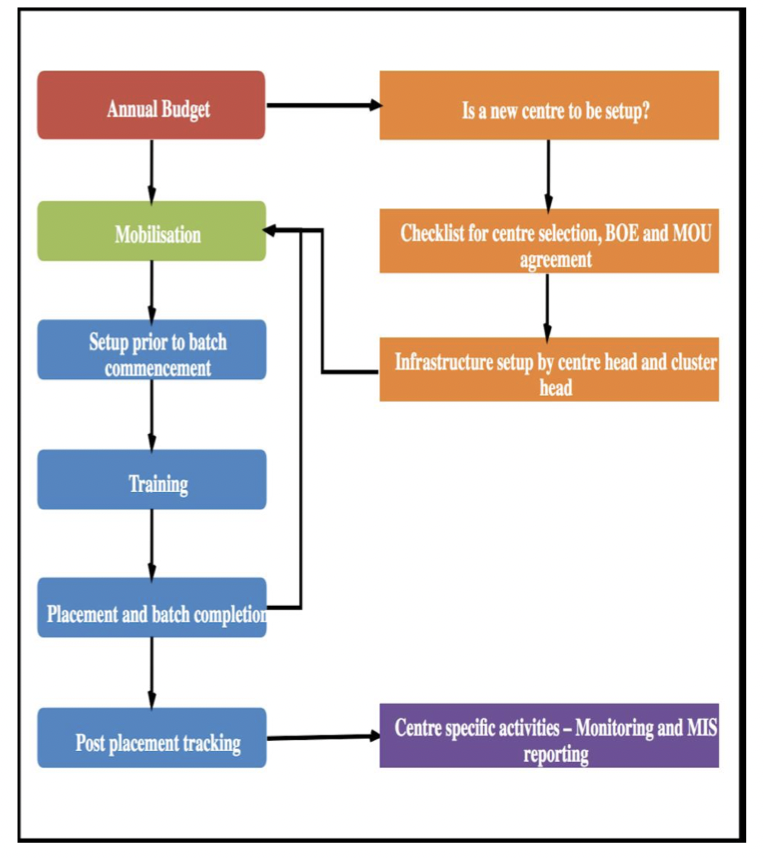
Unnati program life cycle typically runs for 1.5 years and has the following input and sequence of activity for implementation:
Before training:
- Mobilization in the community through door to door contact.
- Need assessment and identification of potential aspirants
- Counseling support to potential aspirants
- Registration process with identified potentials
- Enrolment in particular training program ( aspirant enrolled)
- Central database (CDB)
During training:
- Training joining
- Pre and post assessment during training
- Training completion ( aspirant certified)
After training:
10. Post training support, counseling support and follow up
11. Placement support and networking/linkages with institutes and associations
12. Job retention
13. Alumni tracking
The course domains are as per below:
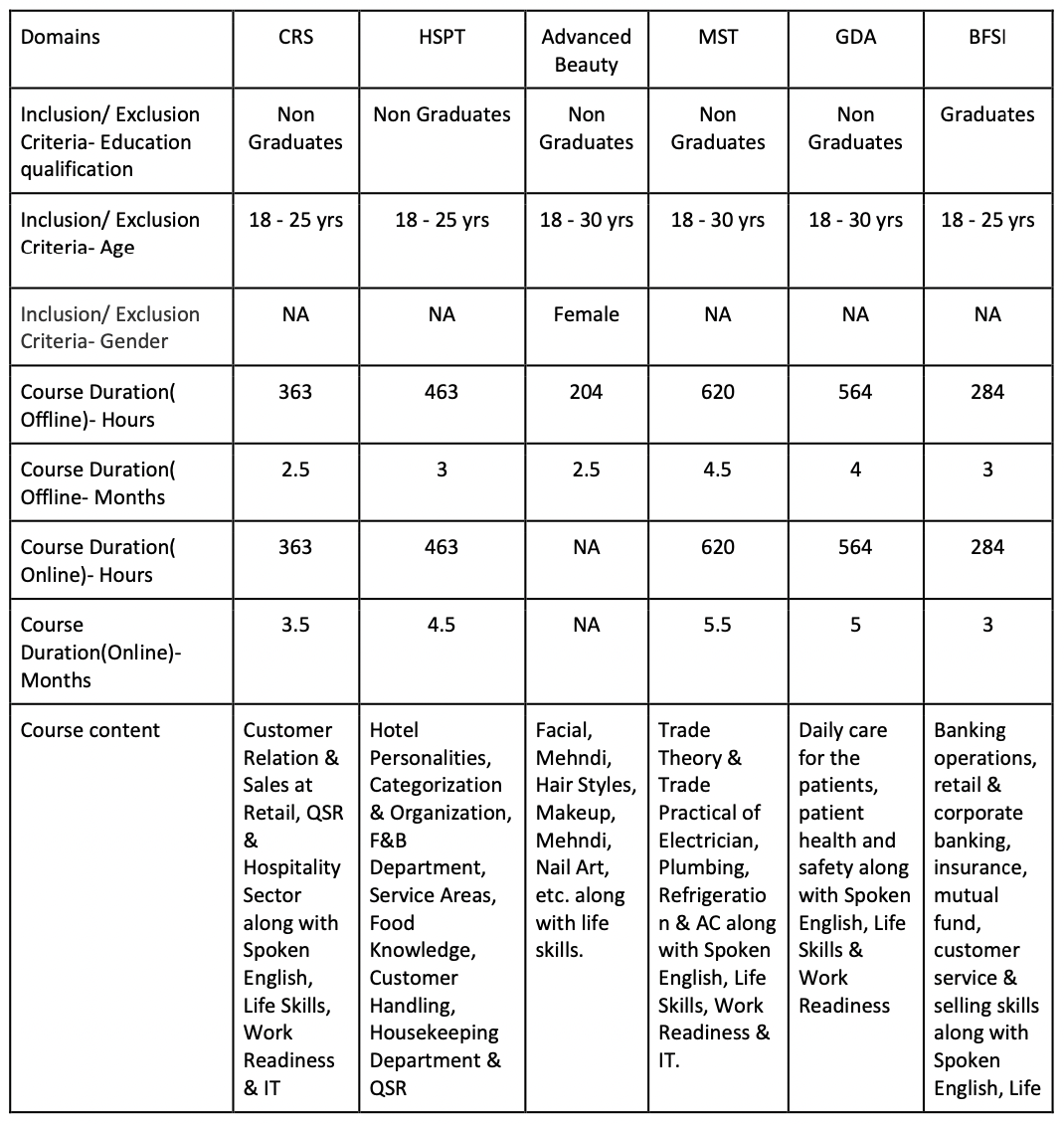
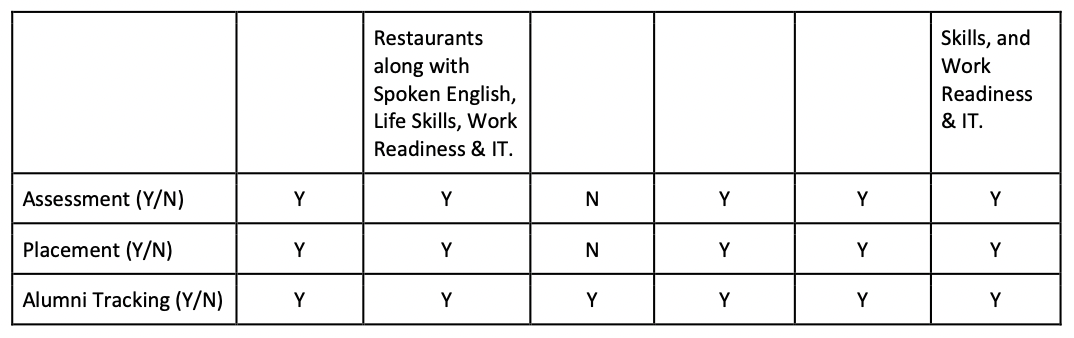
The current program cycle runs in the blended model of offline physical training sessions to online sessions during pandemic. The program is expected to complete the number of input hours as specified in table above by end of March 2022. Domain specific training is conducted in batches with a defined number of aspirants per batch.
For internal assessment, a skill based questionnaire is used to assess the single difference observed during pre and post-test for all the given batches. The change between posttest and pretest categorized as per below:
- One level up in domain specific skills and knowledge
- Two level up in domain specific skills and knowledge
Eligibility criteria for aspirants to participate in post-test:
- Aspirants who participated in pre test
- Aspirants must have attended at least 70% of training hours/ sessions.
Eligibility Criteria for Post-training analysis:
1. Aspirants who are common in both pre and post-test and they are considered as the universe for single difference analysis.
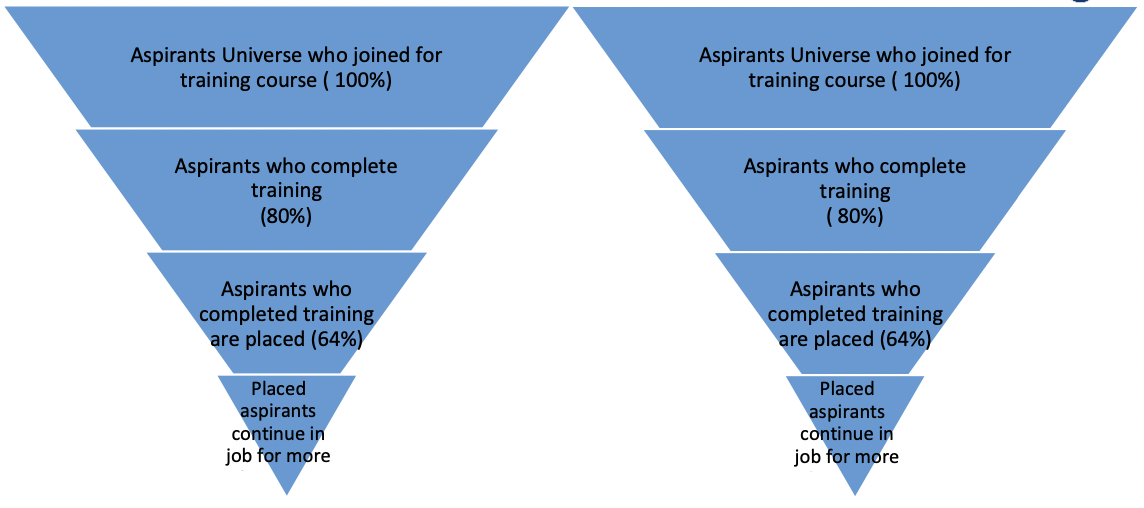
A below pyramid diagram explains the attrition of aspirants in comparison for both Offline and Online operations of program:
Aspirant Demographics:
- More than 90% of aspirants’ universe belongs to BPL family background.
- Female and Male ratio is at 67: 33
- Age group between 18 to 30 years
- Undergraduate and Graduate ratio is 95:5
- Family size is more than 5.
- Priority target aspirants such as single parent, orphans, differently abled( other than BPL)
- Residence of Mumbai and suburban areas
4. Geographical Coverage:
The proposed impact evaluation will be conducted across 10 different centers of Mumbai. Agency will have access to the list and locations of centers with training data for computing a comparison group by using relevant statistical techniques. The outcome evaluation will be conducted in randomly selected trained youths with stratification by centers, domain, medium of instruction training, employment type (placed or self-employed) and location of employment (within Mumbai or outside).
5. Evaluation Hypothesis:
Cohort A: Aspirants who participated in the Unnati programme( between of 2018 to 2020) would produce significant positive effects on household income variations, savings, diverse living conditions, social inclusions, contribution to poverty reduction and other human development skills related outcomes for both female and male when compared with non Unnati counterparts ( with job retention for more than 6 months)
Cohort B: Aspirants who participated in the earlier cycles of Unnati programme (before 2018) would produce significant positive effects on social and economic conditions i.e. financial outcomes, income related outcomes, improved living conditions, enhanced social recognition, transitioning to APL status for both female and male when compared with non Unnati counterparts in workforce economy (with job retention for more than 3 years).
Cohort C: Aspirants who participated in the Unnati programme (between of 2018 to 2021) but could not place in the economy workforce or could not survive in a job for more than 6 months and are currently not active in the economic workforce.
Cohort D: Triangulation of Unnati training, skill assessment, welfare and working conditions( career opportunity, growth, productivity improvement and treatment at work place) through employers/ Recruitment Companies placement cell and departmental heads.
6. Evaluation Methodology:
To understand and estimate the change in an individual’s employability status and cumulative effect on family income, ex post quasi experimental design will be commissioned by KEF and implemented by the external agency.
Since the setting up the baseline for the current and earlier program cycle has not been done to establish the single difference (between before and after the training program) and double difference between treatment and comparison group combined with before and after design. To overcome these methodological challenges, external agencies are expected to propose the appropriate evaluation design which suits the program context and expected change to be observed. Acknowledging that true randomization is not possible, a quasi-experiment based design is expected to be used for proposed evaluation. PSM method alone or in combination with other relevant methods as ex post evaluation design is recommended by KEF however the agency should be open to offer any other rigor evaluation design which may be applicable and more relevant in livelihood context. It is essential for KEF to generate evidence for the change brought about by the program and hence the recommendation to estimate counterfactuals through comparison groups. Also, learning from this evaluation exercise about what worked well and what could have been done differently.
As part of the technical proposal, the agency is expected to explain the rationale for selection of appropriate methodology. Critical steps require mentioning how the proposed design will account for minimization of selection bias and contagion. A clear mention of how the comparison group will be formed and which all characteristics used to match or compute the comparison group is essential to include.
7. Sampling Design:
The representative sample size for both the program and comparison group is estimated at the same. Agency is expected to apply stratification for segmentation of aspirants as per different cohorts. Multi stage sampling design is expected to be used to determine the minimum required sample size. The base for sample size computation would therefore depend on multiple factors which need to be presented in the proposed sampling strategy by the agency in the technical proposal. This should include explicit mention of the unit of data collection and proposed respondent against which the comparison group characteristics will be formed.
To achieve the evaluation objective, there will be 4 separate cohort considered for sampling and sample size estimation:
Cohort A (Aspirants trained between 2018 to 2020)
Universe for sampling: Intervention Group
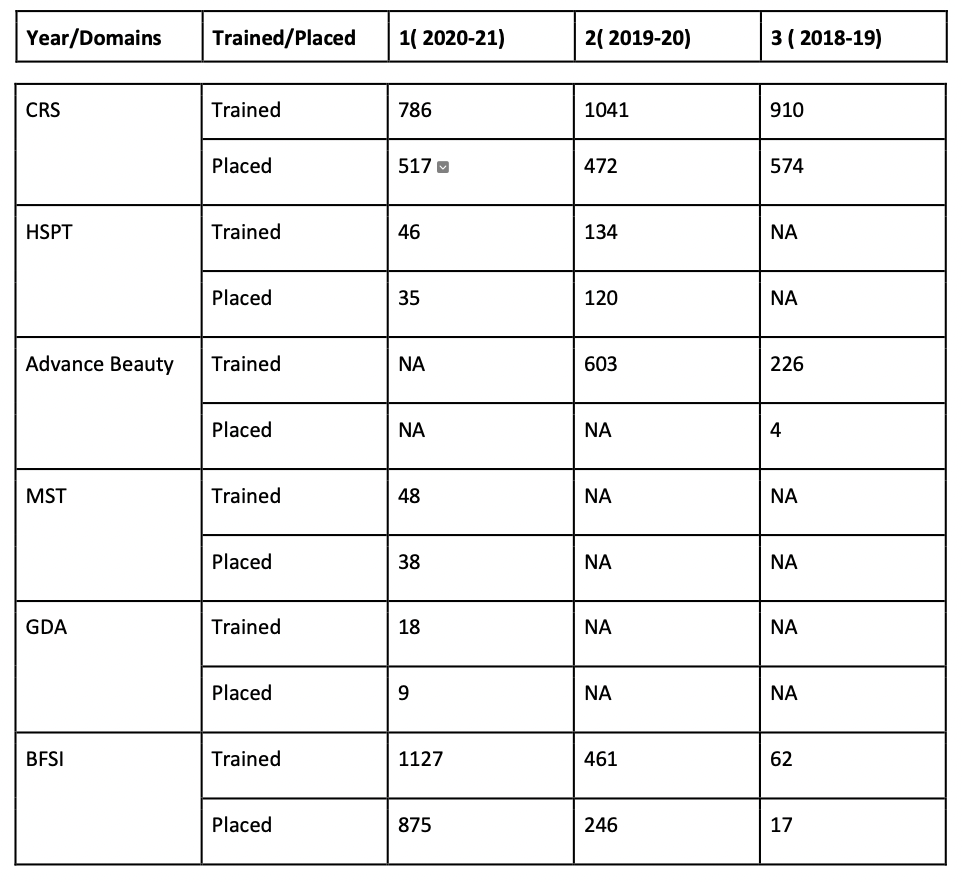
Aspirants from year 3 will have 3 years of exposure to job placement or retention in job. (Sub-Cohort
1) The aspirant universe for this cohort will be 1198 aspirants trained and 595 placed. Aspirants from year 2 will have 2 years of exposure to job placement or retention in job. (Sub-Cohort
2) The aspirant universe for this cohort will be 2239 aspirants trained and 838 placed. Aspirants from year 1 will have 1 year of exposure to job placement or retention in job. (Sub-Cohort
3) The aspirant universe for this cohort will be 2025 aspirants trained and 1474 placed. These three groups of aspirants will form a universe for sampling. Agency is expected to plan the sample size computation keeping this cohort at the center. The same mechanism will be followed for establishing a comparison group sample size.
Cohort B (Aspirants trained before 2018)
The universe for this cohort would be the aspirants who graduated successfully from the program cycle at least 3 years before and they are currently active in the economic workforce. A random selection of aspirants will be done to assess their continuity in the economic workforce and skill upgraded to meet the higher order job requirement. A representative sample would be required to derive from the universe of 10200 aspirants.
A comparison group will be formed to assess the magnitude of change brought about the Program among graduated aspirants.
Cohort C (Aspirants from Cohort A program cycle but not placed and inactive in workforce)
The universe for this cohort would be the aspirants who graduated successfully from the program cycle but could not place in the job market. A random selection of such aspirants will be done to assess the reasons for exclusion from the economic workforce, time spent in job hunt, domain specific job market conditions. A representative sample would be required to derive from the universe of 2171 aspirants who belong to the cohort of year 2018 to 2020.
No comparison group is expected to form as this will be a qualitative assessment to inform the expansion strategy.
Cohort D (Employer/ Recruitment agency placement cell)
The universe for this cohort would be the employers/ recruitment/placement agencies who offered the job to Unnati graduates. A random selection of such employers will be done to assess the effectiveness of domain specific training, change market conditions (employable skills suitable for placement of jobs, skills and capabilities of aspirants and growth opportunities. A representative sample would be required to derive from the universe of 298 mutually inclusive employers (CRS-123, HSPT-123, MST-04, GDA- and BFSI-118, GDA- outsource to external agency for placement) who provided placement to aspirants from the cohort year 2018 to 2020.
No comparison group is expected to form as this will be a qualitative assessment to inform the expansion strategy.
The list of all operational centers, aspirants, alumni and employer list (as per applicable to cohorts of A, B, C and D) will be provided by KEF to the onboarding agency post to completion of the selection process.
8. Sample Size and Effect Size:
Adequate estimation of sample size is essential to prevent the conclusion of a program’s effect in a false positive or false negative manner .It is mandatory for agencies to clarify the size of effect (magnitude of difference between program and comparison group) being considered for computation of sample size. Agency may consider the benchmarking from similar intervention and comparison with cost of evaluation to propose the MDSE (minimum detectable effect size) for this evaluation.
Similar to other impact evaluation, Unnati evaluation will heavily rely on rigor of statistical tests to determine any observed difference between groups and the associated statistical significance differences (to establish that observed change is due to effect of program and not by chance). Effect size defined above will help to calculate the required sample size to confidently identify the change. Agency is expected to compute the estimated sample size for all 4 cohorts in sequential manner. A clear tabular matrix with minimum required sample size (with mention of confidence level, Power to estimate change and precision) is required to submit along with a technical proposal.
A comparison chart displaying the difference in sample size due to different levels of effect size ranging from small, medium and large. Estimation of sample size to provide reliable estimates for each domain and representative to each offline centres.
9. Mixed method tools:
Following tools recommended to use for data collection to support the objective of evaluation: Primary Target Group:
1. Home visit tool to interact with aspirants- in job
- Home visit tool to interact with aspirants- not in job( trained aspirants)
- Home visit tool to interact with drop out or opt out aspirants- non graduate aspirants
- Home visit tool to interact with aspirants who got placed but not tracked as part of alumni.
- Skill based assessment/test for aspirants- not in job( trained aspirants)
- In-depth interview with employer/ recruitment company representative
- Transect walks and on site observation of training centers
- Physical verification tool for job placement, income and retention
- Case study based data collection through observations
Secondary Target Group:
10. FGD with program team- mobilizers
11. In-depth interview with Unnati center’s trainers
12. In-depth interview with Unnati core team members
13. In-depth interview with parents/family members
14. In-depth interview with Alumni tracking agency representative
15. Mapping of most significant changes while interaction with program team and aspirants
10. ROI ( return on investment) to assess the Value for Money:
In combination with mix method design, the agency is expected to submit the analysis plans as to how the program benefits associated with the cost incurred by the program. Proposal of a well accepted method (or combination of methods) which has potential to triangulate the evaluation findings with investment done under program. Agency is expected to include various indicators for instance, cost benefit ratio, cost effectiveness ratio and cost impact ratio along with RoI (Return on Investment at individual aspirant level and overall) as part of a technical proposal to define the range of benefits justified by the program. The shortlisted agency will have access to the program cost details to perform the ex post analysis of cost –benefit.
11. Data Analysis:
The Selected Agency would be responsible for analyzing the evaluation data, compare and analyze the data against set evaluation parameters, computation of various indicators like ATE – average treatment effect and agreement treatment effect, ATT- average treatment effect on treated and ATU- average treated effect on untreated ( if observed any). The report should include the section of advance analytics where multiple regression and other high order relationship analysis performed between the groups and explain the same in non-statistical terminology. A literature review and benchmarking with similar interventions/projects or programs will be necessary condition for KEF before approving the data collection tools and analytical plans.
12. Data Collection Procedure:
The data will be collected using digital device either SurveyCTO or Kobo toolbox. No paper based format recommended to use for any type of quantitative data collection. The tool used for assessment will be designed and developed by selected agency. A manual on data collection guidelines is mandatory to prepare before the pilot of tools. To ensure the diversity of evaluation, a separate tools are expected to develop for all four cohorts. Both the tools and associated guidelines need to approve by KEF before processing for main evaluation (post to pre- test of tools and methods).
13. Data Entry Procedure:
Cleaned, completed and well coded data collected through qualitative method would require to process either in N vivo or Atlas- Ti. A transcription and content analysis should be supported by higher level qualitative analysis. Agency is expected to take the note for their tabulation plan as how the qualitative findings will be supplemented with quantitative analytics.
14. PRE-QUALIFICATION / ELIGIBILITY CRITERIA:
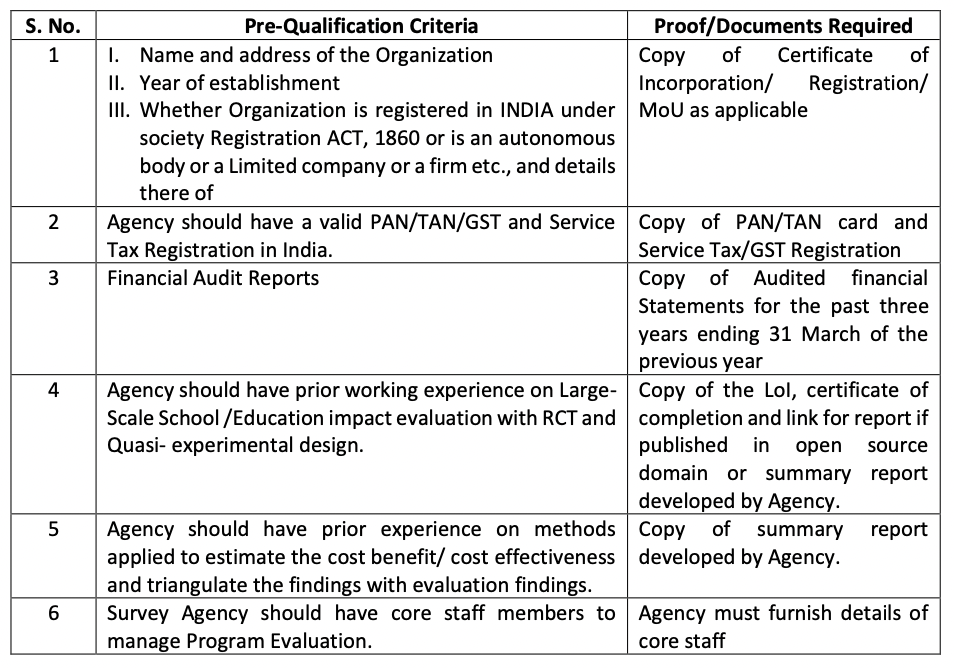
This invitation to proposal is open to all agencies meeting the following minimum eligibility criteria: 14.1 The agency should be a Company registered under Companies Act, 1956/ Society Registration Act, 1860/ Autonomous Body/ Partnership Firm in existence for the last 3 years.
14.2 The agency should have a valid PAN, GST number and Service Tax Registration in India.
14.3 The agency should have conducted large scale surveys in skill development, livelihood, income generation and employability based program impact evaluation.
14.4 The agency should have experience in conducting the quasi- experimental design based evaluations by using the PSM (propensity score matching) method.
14.5 The agency should have experience in conducting impact evaluations as ex post single/double difference design in which any other quasi- experimental methods being used to conduct cross sectional evaluation.
15. SCOPE of WORK:
The technical and financial proposal should consider the following as scope of the work:
15.1 The agency will be required to appoint the following human resources for this evaluation project:
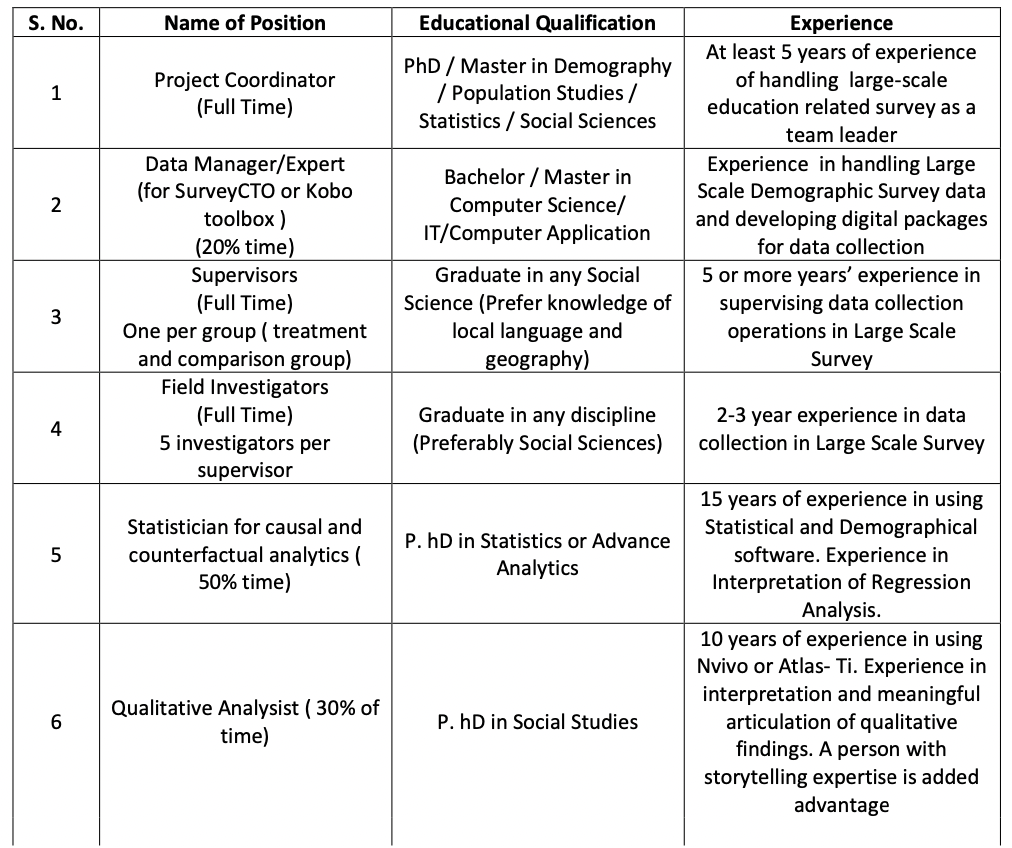
The selected Agency will have to provide the details of their team earmarked for the evaluation for the said duration in advance with proposal submission. Upon selection of agency, no changes will be expected in the team composition and replacement request for position number 1, 5 and 6 will not be accepted.
15.2 Training of Field Investigator and Supervisors:
Selected agency will be responsible for conducting multi- days Training of field investigators and Supervisors. A Training of Trainers (ToT) to be organized for key resource person. The ToT training venue and training materials shall be managed by selected agency.
Upon completion of ToT, training to field investigator and supervisor need to plan. The trainers from agency will organize multi- days training. The KEF team members will be monitoring both the trainings i.e. ToT and field staff training. Cost of travel and stay of the officials and field team from agency for attending training will have to be borne by the agency.
The agency will invite 10% extra field team members for training as some members might be asked to withdraw due to less understanding about the evaluation or wrong recruitment.
15.3 Defining Fieldwork Plan: Agency will have to chalk out the fieldwork plan for the entire project duration and also need to prepare the detailed monthly plan including the deployment of field survey teams. A use of Gantt chart for this planning is recommend to include in proposal plan.
15.4 Outcome Evaluation- Field implementation:
Selected Agency will have to ensure complete coverage by carrying out evaluation field work in selected samples under the category of treatment and comparison group. The field work should be completed within prescribed time limit.
15.5 Quality Control: Selected Agency will be required to ensure quality of data collected by adhering to the following:
The Field Survey Teams should ensure complete coverage of the samples in the selected units. They should ensure that all the reported data are valid and also verify the contents of surveyed schedules by undertaking a thorough checking. Due care should be taken for giving correct codes for different levels. Agency will have to rectify errors/ data quality failures identified during data cleaning. Regular monitoring will be carried out by KEF project officials to secure the overall quality of data. A note on quality control assurance mechanism is expected to submit along with the technical proposal.
15.6 Development of Digital data collection forms/ Tools:
The Agency would be responsible for development of digital data collection tools either on SurveyCTO or Kobo toolbox. Agency need to ensure the compatibility or any other IT specifications before the forms or tools development. All the skipping questions and validation rules should be used appropriately in the form package. The agency will submit the digital app package to KEF for testing and approval before starting of field work.
15.7 Data Finalization:
The Agency would be responsible for finalization of the collected and cleaned data for the further processing, factoring in the quality checks and observations of KEF officials. Agency would also be responsible to satisfactorily answer any queries raised by KEF during the finalization of the data for analytical purpose.
15.8 Progress Report on Field update:
The Agency would be responsible for daily /weekly progress report about the data collection and coverage status. Progress report will be further linked with each payment schedule.
15.9 Final Evaluation Report:
The Agency would be responsible for submission of final version of program evaluation report and share the interactive presentation of report. This will be done in phased manner upon receiving feedback from KEF.
15.10 Project Closure Report
The Agency would be responsible for submission of project closure report (approved by KEF) and the final payment will be linked to the approved report.
16. IMPLEMENTATION SCHEDULE:
16.1 Implementation Plan:
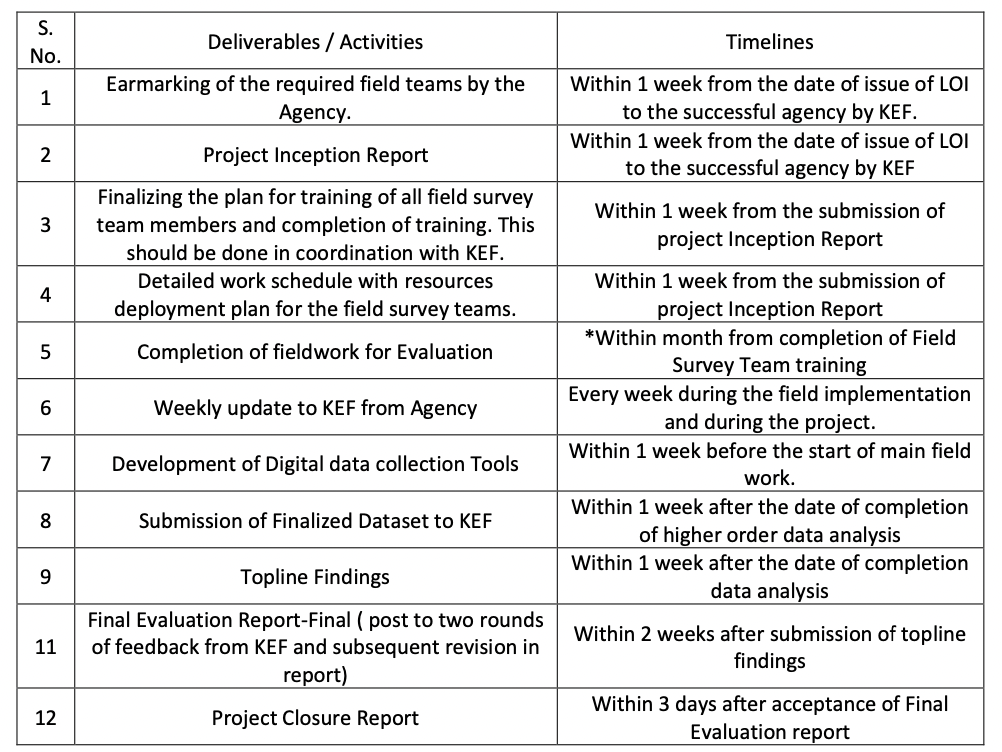
Deliverables / Activities Time Lines: Agency is required to complete the fieldwork as per schedule from the date of starting the project by adhering to the time schedule prescribed by KEF. The agency would be required to deliver as per the implementation schedule provided below:
16.2 PAYMENT SCHEDULES:
The payment schedule will be based on defined deliverables under the project. The agency is expected to submit the payment schedule with the financial proposal.
17. GUIDELINE FOR SUBMITTING PROPOSALS: 17.1. Technical Proposal
Proposal should be inclusive of the following: 17.1.1. Organizational Profile
I. Name and address of the Organization.
II. Year of establishment.
III. Legal status of the Organization – Whether Organization is registered under society Registration ACT in India or is an autonomous body or a Limited company or partnership firm, etc., and details thereof (e.g., name(s) of partners, Managing Directors, Chief Executive Officers, key persons)
IV. Principal nature of activities undertaken in past 3 years.
V. Organizational structure and names of personnel, their titles, and curriculum vitae including nature of appointment and duration with the organization of the key personnel proposed to be involved in this project.
VI. Communication details of the organization: mailing address, telephone and fax numbers, email address, LinkedIn address etc.
VII. Organogram of the organization and proposed organogram for KEF project.
17.1.2. Impact Evaluation Experience:
I. Area of specialization and nature of evaluation conducted. Mention of experience particularly in skill based, livelihood based RCT, quasi- experimental and other form of impact evaluation (Enclosed copy of the papers, letter of engagement, etc.)
II. The geographical coverage (State/UT) of evaluation conducted by Agency. List of impact evaluation project conducted in the past in Mumbai or other metro cities.
III. List of large-scale demographic and/or skill development, livelihood, employability and/or social sector surveys conducted by the Organization with information on geographical area covered.
IV. Names and addresses of sponsoring or funding agencies for whom the earlier evaluations were conducted. (Indicate key person’s name and contact details of sponsoring/ funding agencies).
V. The cost of each impact evaluation conducted should be submitted separately in a tabular format.
17.1.3. Financial Status of the Organization (For the past 3 financial years):
I. Total revenue and expenditures of the organization.
II. Latest copy of the certified Audited Annual Accounts in support of the Financial Status.
17.2. Financial Proposal:
I. The financial quotes should cover the entire cost of the evaluation including training, travels & allowances, all resource costs etc.
II. The total cost quoted should be inclusive of all taxes.
III. Payment Schedule linked with key deliverables (max up to 5 deliverable to consider)
17.3. Submission of Proposal:
The agency shall submit all documents in a compressed format and send over the official email provided by KEF. Proposal must consist of the following:
a. Eligibility criteria as per the criteria given in Annexure “1” of this RfP.
b. Technical proposal, with PDF attachment named as Agency name_ Technical proposal for Unnati Evaluation.
c. Financial proposal as PDF attachment named as Agency name_ financial proposal for Unnati Evaluation.
d. The official email containing the Technical and Financial Proposals are submitted as an attachment, with the subject line “Agency Name_ Proposal for conducting outcome evaluation of KEF’s skill development program.
All the pages of the Financial Proposal shall be duly signed by the authorized signatory of the Agency in ink before submission. Corrections, if any, shall be countersigned.
18. Evaluation of the proposal received from the Agency:
An evaluation committee of KEF, would examine both the technical and financial proposals based on the details provided in the Invitation for proposal for those agencies who are short listed as per the eligibility criteria for technical evaluation.
19. Award of Contract:
KEF will notify only those Agencies, whose proposal meets the minimum requirement of qualifying marks. Total Score of the eligible and technically qualified agencies would be considered for the award of the project. Cost of preparing the proposal and incidental expenses shall be borne by the respective agencies. On completion of selection process, the agency selected shall be awarded the contract of evaluation project by issuing the Letter of Intent (LoI).
Evaluation kick off date- 1oth March
Evaluation duration – 1 month from date of contract.
20. Submission of Proposals to KEF:
The proposal, along with all the correspondence and documents exchanged by the Agency and KEF, shall be written in the English language.
No Proposal shall be accepted through courier or hand post to KEF office. For submission of proposals official email ID provided by KEF should be used.
The Financial Proposal will be evaluated only when Agency has qualified the technical proposal. The proposal will be valid for 90 days from the date of submission; KEF will make its best effort to finalize agency within this period.
The agency is advised to attach any additional information that is considered necessary to establish its capabilities. No further information will be entertained after submission of email unless it is required by KEF.
Proposals must be received by KEF, at the following EMAIL address:
Email: rfp_merac@kotakeducationfoundation.org
KEF reserves the right to cancel the RFP at any stage without citing any reason. Last date for receiving queries: Up to 1700 hours on, 3rd March 2022. No queries post this date shall be entertained.
Last date for submission of complete proposal with all supporting documents (by EMAIL only) is 5th March 2022 up to 17.00 PM. Any proposal received after the prescribed timeline will not be entertained. KEF will not be responsible for any technical glitch or delay submission of email or loss of attachment over email due to attachment size limit.
ANNEXURE-“1”
ELIGIBILITY CRITERIA FOR TECHNICAL EVALUATION OF SUBMITTED PROPOSAL:
The eligibility criteria for the Agencies to qualify for the technical evaluation have been provided in the table below: