
Demystifying Climate Data for Communication and Action
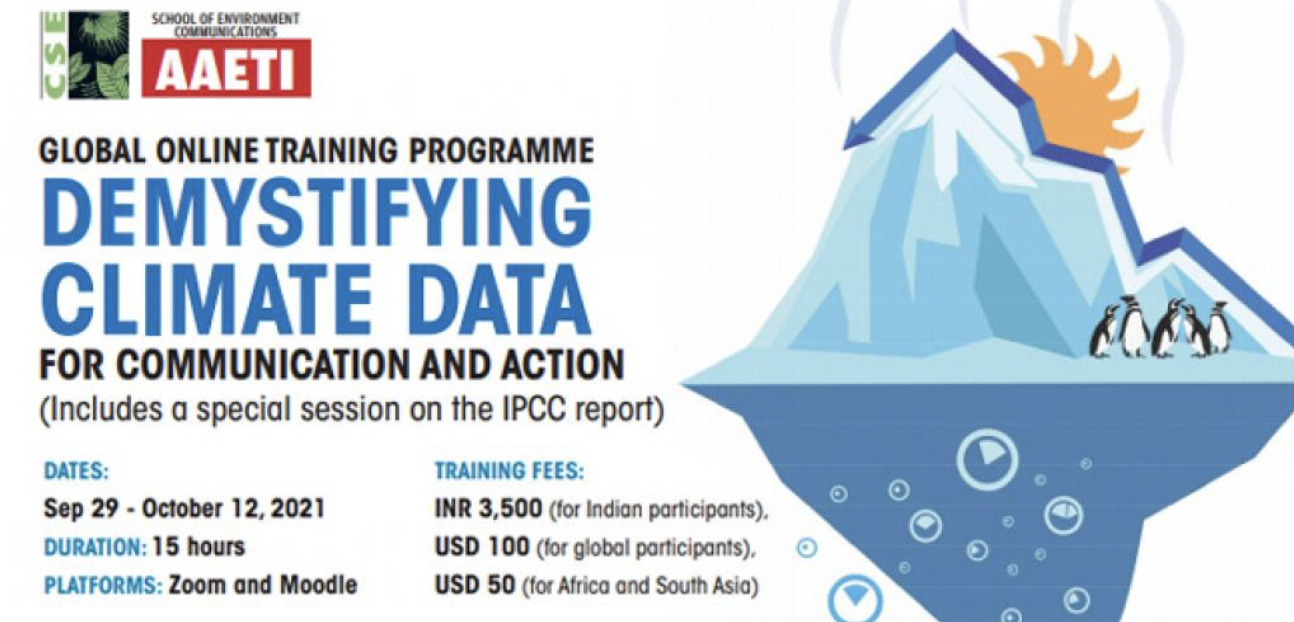

Sep 29th – October 12th, 2021
Sattva is driven by impact and powered by knowledge. We bring the right balance of head-heart-hand to our work. We believe that age-old problems need new-age thinking and rigorous implementing, with empathy at the core.
And that’s what we deliver for our customers and partners.
At the heart of our work is the ability to collaborate with multiple stakeholders, and co-create inclusive working models that help each organisation achieve its own place in the Magic Quadrant – where its economic value as well as social impact is maximised.
Climate change poses an existential threat to humanity. It is the biggest social, political, economic and environmental challenge faced by the world today. While countries continue to reluctantly align themselves to meet their climate change promises, communicating the urgency of this crisis remains a challenge for most stakeholders.
The critical state that the world is in has been amply re-emphasised by the recently released first part of the Sixth Assessment Report (AR-6) of the UN Inter-governmental Panel on Climate Change (IPCC). The report, which provides the most up-to-date understanding of the climate system and climate change, unambiguously holds human activity responsible for climate change and projects its future impacts on us.
Centre for Science and Environment (CSE), one of South Asia’s leading think tanks on the politics of development, environment and climate change, invites you to join its Global Online Training Programme which focuses specifically on one critical aspect of meeting this challenge: understanding climate data and analysing it, and using it to tell climate change stories to different stakeholders.
The Training Programme will also have a special session on the IPCC’s latest report.
The Programme is designed to inform about established as well as new trends and approaches in data-driven development communications for effective presentation and maximum impact. It will also introduce popular analytical tools and conceptual frameworks, and offer insights into the global legal framework and politics to better understand climate-related numbers.
What will you learn?
- Data collection: Learn how and where to research for relevant data on climate change and development.
- Data analysis: Develop skills to analyse and interpret trends on climate science and impacts.
- Data visualisation: Learn to visualise data for effective communication.
- Report writing: Develop skills to process, visualise and transform climate data into simple, compelling and informative ‘stories’ for print and web.
Who can attend?
- Professionals, government officials and policymakers working on climate change.
- Academia: Faculty and researchers, and students associated with climate and sustainable development
- Researchers and writers on climate and development
- National and international civil society groups, NGOs, climate activists and advocates
- Industries: CSR officers, Public relations/Communication officers
- Data managers and statisticians interested in improving communication skills
- Anyone else interested in the subject
Course structure
The self-paced online programme will have video lectures, presentations, tutorials, quizzes and assignments. Participants will also get an opportunity to work on an in-depth project of their choice. The programme will also have three live interactive sessions for meeting the trainers and fellow participants. The programme has been designed in such a way that it can be completed along with a regular job or study.
| COURSE FEE | |
| Rs 3,500 for Indian participants US $100 for Global participants US $50 (for Africa and South Asia) |
The course is broken down into five modules:
Module 1: Introduction to climate change: science, politics and impacts
Module 2: Data for effective communication and informed decision making on climate change for development – The World in my Backyard
Module 3: Finding the right data on climate
Module 4: Data processing and analysis to make data meaningful
Module 5: Data visualisation
COURSE DIRECTOR
Kiran Pandey
Programme director, Information Management, CSE
COURSE COORDINATOR
Susan Chacko
Manager,
Information Management, CSE