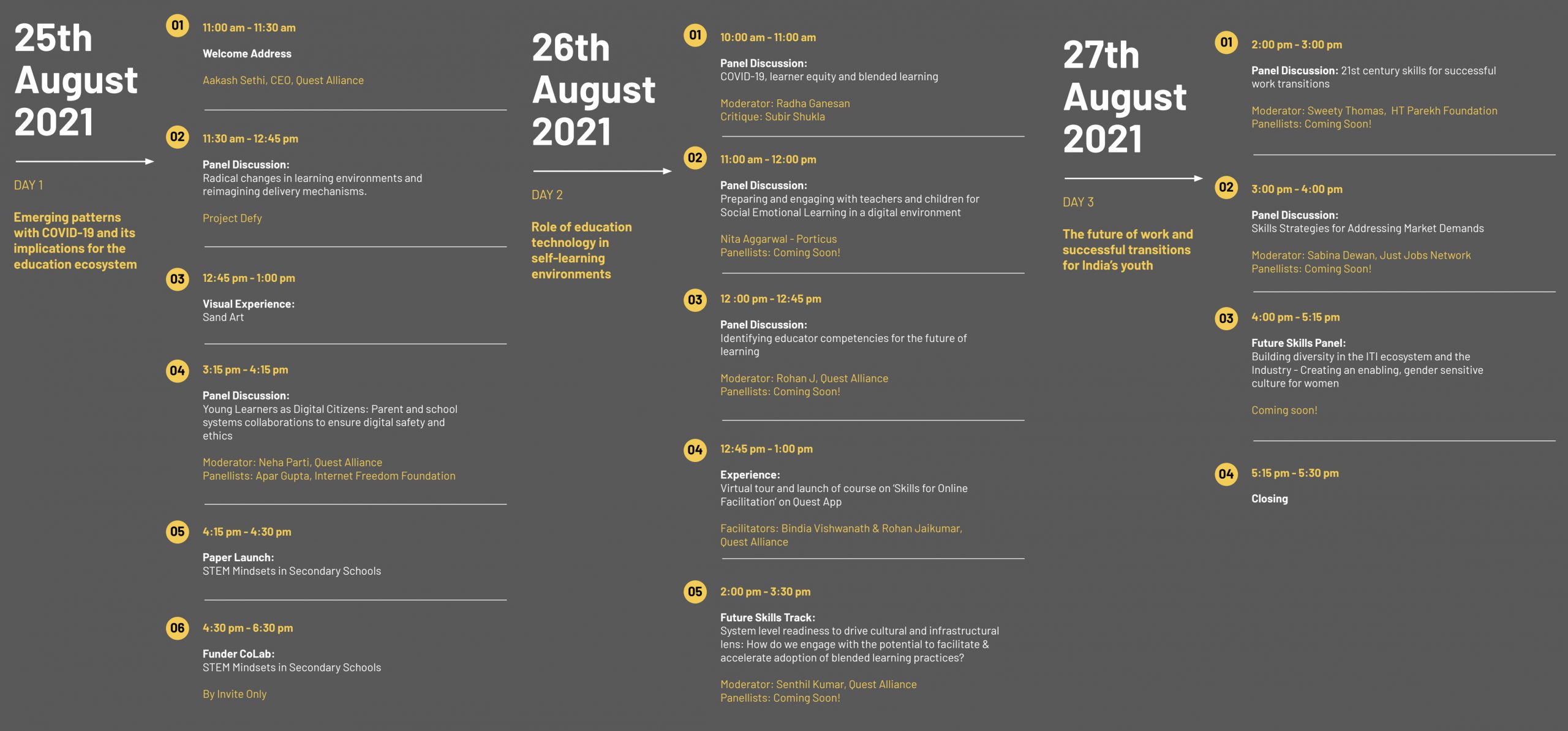
Quest2Learning Summit 2021

25th to 27th August, 2021
Facilitating self learning pathways for successful school-to-work transitions of young people
As the full impact of the Covid-19 pandemic on learning and education continues to unfold, the undeniable fact is that this global crisis has challenged age-old, entrenched ideas about classrooms, the role of educators, and traditional methods of learning. Young people today will need to navigate a volatile, uncertain, complex and ambiguous future, which will require a reimagining of thinking processes, and the ability to make informed decisions with agility.
In this context, self learning has the potential to fill the critical gap around learners’ agency to control what they learn, and when and how that learning takes place. Self learning is not just a skill or attitude, it is a way of operating in a changed world. Nurturing young people as self-learners, and creating self-learning environments will require forward thinking within the education and learning ecosphere. Systems, structures and processes will need to be geared towards enabling students – undeterred by their gender, age, class, caste, religion or ability – to exercise their agency, and operate as resourceful, resilient and capable thinkers.
This can only come about when the state, civil society organisations, educational leaders, policy makers and educators collectively pool their energies and efforts towards this shared common goal.
Quest 2 Learn 2021
Quest to Learn (Q2L) is the Knowledge, Innovation and Organisational Learning initiative at Quest Alliance. Q2L is a co-learning space and platform where learners, educators, policy makers, funders and civil society leaders come together to partake in conversations, highlighting diverse perspectives on the emerging trends of work and learning that affect school to work transitions. Our ultimate goal is to facilitate the building of knowledge and innovation in the school to work ecosystem, and make space for innovative and emergent ideas. This year, Q2L will host a series of dialogues, webinars, and panel discussions on emphasising the relevance of self learning to enable successful school-to-work transitions for our young people in a world struck by the pandemic and other such uncertainties.
The annual Quest 2 Learn Summit brings together practitioners from across the world to share best practices and insights, engage in dialogue, analyse new trends in learning, validate approaches, and build on new ideas around the education-skills divide.
This year, the Annual Summit will be a digital convening where participants experience the relevance of self learning in a world struck by the global pandemic. Through meaningful dialogues and insightful perspective from students, educators, government and civil society, the Annual summit will aim to answer a key question: How to enable successful school to work transitions for young people in a VUCA World.
Themes
1. Facilitating self learning environments.
2. Equity and inclusion in future careers, in a world of pandemic and environmental crisis.
3. Systems change to strengthen collaborative action in the education and employability sectors.
Facilitating self learning environments
Explore a new narrative that shifts power to learners and prioritizes learner autonomy and cognitive skills. Sessions under this theme will unpack the concept of what excites learners, what learning spaces mean to them, and how learning spaces are being redefined in a VUCA world.
a. Teaching environment: Mastery, agency and purpose at the core of educator capacity-building approach
b. Learning environment: Fostering 21st century skills for greater collaboration and enhanced peer relationships. The role of the home environment as a learning space, and how it can be fostered.
c. Role of technology: The digital divide, knowledge of effective use and orientation of learners & educators with a new mindset. Onboarding of parents and their role to inculcate an environment of learning at home.
d. Systemic support: Essential systemic, administrative and cultural support for educational institutions which enable the shift in teaching and learning methodologies, and drive the adoption of self learning in classrooms.
Equity & inclusion in future careers, a world of pandemic and environmental crisis
Discover opportunities and challenges young people face in building careers in a VUCA world, and the role of 21st Century skills in successful school-to-work transitions. Sessions under this theme will unpack new employability trends, the rise of new career opportunities and greater prospects for financial independence against the backdrop of very real challenges like the lack of access to resources and opportunities for growth, and cultural barriers related to gender, caste and economic status.
Systems change to strengthen collaborative actions in the education and employability sector
Engage in dialogues that examine how 21st century education systems will become pathways through the crisis of learning disruptions. Sessions under this theme will focus on how enhanced engagement with government systems, policymakers, policy and budget influencers can bring a shared ownership on systems change. With marginalised communities and resource deficit ecosystems as a focus, delve into what institutions, school leaders and educators need in order to deliver a more integrated, real-world relevant 21st century model that facilitates youth well being, aspirations and social justice.